
The two-places problem
A deal closes in your CRM. The dealer pays you in pieces. A bank deposit shows up in your account. Someone has to connect all three, usually by typing the same numbers into separate software at the end of the month. Mistakes creep in, and the question "who still owes us?" has two answers depending on where you look.
The Accounting package is LeaseDash™'s answer for the lease desk: the books live beside the deals, so a closed deal and a dealer payment go into the ledger as you work.
What is in the Accounting package
- General ledger with a chart of accounts, journal entries, income and expenses, and your own expense categories.
- Money reports: profit and loss, cash flow, balance sheet, income and expenses by category, and 1099-style payee totals.
- Bank connections: deposits and card charges come in for you to sort. Deposits are matched to the deals dealers owe on, and you confirm each match. Bank rules can sort lines for you or only suggest.
- Vendors and bills: enter what you owe with its due date, see what is overdue, and record payment of several bills at once from a bank or card account. An accounts payable aging report shows who you owe and how late.
- Bank reconciliation: you type in the date and ending balance from your statement and tick the lines that appear on it. You can finish only when the difference is 0.00, and a report is saved.
- Receipts: attach a photo or PDF (up to 10 MB each) to an expense, bill or journal entry.
- Closing and budgets: close a month so nobody can change it, set a budget for each account by month, and compare it with what actually happened.
- Payroll & payouts: people paid, commission payouts from your deals, pay runs, owner draws and 1099 contractor totals.
- Exports and sync: Excel or CSV (print or save as PDF), a ledger file ready to import into other accounting software, and sync with two accounting programs, listed on the features page.
Why books next to deals helps
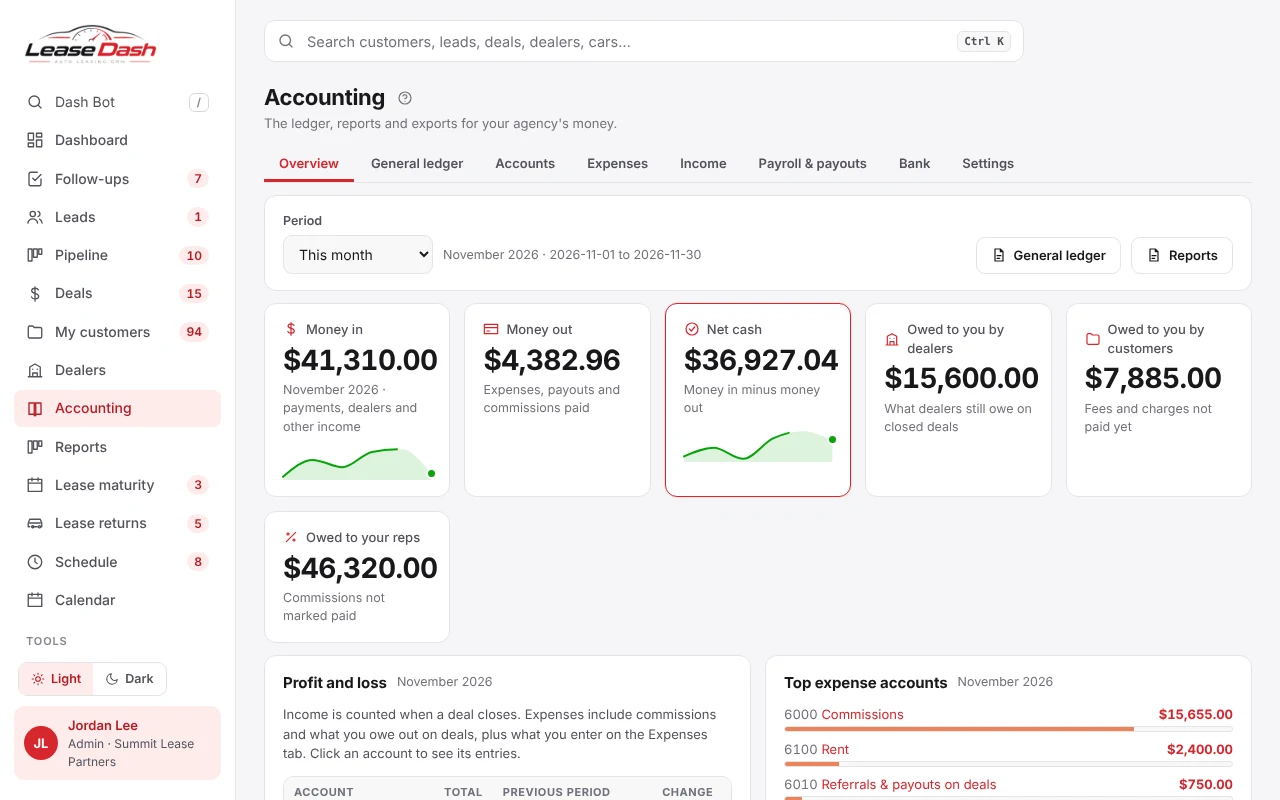
The accounts you care about at a lease desk are mostly about deals: who owes you, what your reps are owed, what you paid out. In the Accounting package those come straight from your deal money. The overview shows money in, money out, net cash and what dealers, customers and reps owe. Dealers who owe you, customer balances and commissions by rep are reports you can run in every plan; the Accounting package adds the ledger and the bank behind them.
You also get one set of permissions and one audit log. Payroll and the books are visible to the people you choose (Admins by default), and what changes is written down.
Versus juggling separate accounting software
Separate accounting software is a good choice if you want everything that comes with it, and many agencies keep their accountant and their tax software. The Accounting package is not trying to replace those for every agency. It is a good fit if the main job is keeping the lease desk's money straight without retyping between systems. The trade-offs are plain:
| Question | Books next to your deals | Separate accounting software |
|---|---|---|
| Where do deal numbers come from? | Straight from your deals, as you work. | Typed or imported from the CRM. |
| Who owes you, by dealer? | On the same screen as the deal. | Depends how it was entered. |
| Logins and permissions | One set, with an audit log. | A second set to manage. |
| Handing off to an accountant | Export to Excel, CSV or a ledger file, or print or save as PDF. | Native to that software. |
If you already use accounting software you are happy with, you can send your books to it rather than switching, using the exports or the sync.
What it does not do
Bills are a record of what you owe: LeaseDash does not send payments to your vendors. Bank reconciliation checks your books against a statement you type in; it does not pull statements or move money. Payroll & payouts is a record of what you paid: LeaseDash does not file payroll taxes. It does not replace your accountant or your tax filing.
What it costs
The Accounting package is $49 a month on the Team plan, which is $409 a month by card (card processing included), or $3,999 a year by bank (ACH) or $4,099 by card. It is included on the Agency plan ($819 a month by card, or $7,999 a year by bank or $8,199 by card), and it is not available on the Solo plan. Every plan starts with a 14-day free trial. Details are on the pricing page. Some help articles still call this package Back office; it is the same thing.
Learn more
The help center walks through each part: what the package includes, connecting your bank, entering and paying a bill and reconciling your bank account. For deals and commissions first, see dealer payments and commissions, or book a demo.