
The short version
If you are one person with a few dozen customers, a spreadsheet may be all you need today. If your list is growing, if several people touch it, or if you are tracking what dealers owe and what reps are paid, the cracks start to show. A generic CRM fixes some of those, but it was not built around lease-end dates, dealer money or turn-ins. LeaseDash was.
When a spreadsheet is enough
- You work alone, or with one trusted person.
- You have a small number of active customers and remember when their leases end.
- You are tracking money in your head or in a separate sheet, and it still balances.
A spreadsheet costs nothing, and you control it completely. That is a real advantage, and there is no shame in starting there. The honest question is what happens when it stops being enough.
Where spreadsheets break down
- Nothing nudges you. A lease-end date in a column does not remind anyone. Someone has to sort and scan it, every week, forever.
- Several editors. Two people changing the same file means overwritten rows, copies named "final-v3", and no record of who changed a number.
- Sensitive details. Spreadsheets hold names, phone numbers and sometimes birth dates or license details in plain view. LeaseDash masks private details until someone with permission reveals them, and writes each reveal to an audit log.
- Money by hand. Dealer-owes, net profit and commission are formulas you build, copy down and hope nobody overtypes.
- Everyone sees everything. There is no simple way to let a rep see only their own customers.
Where generic CRMs fall short for a lease desk
Generic CRMs are good at what they were built for: sales pipelines, contact records and a large number of integrations. Some can be customized heavily. But a lease desk has needs that are not in the box, and you would be building them yourself:
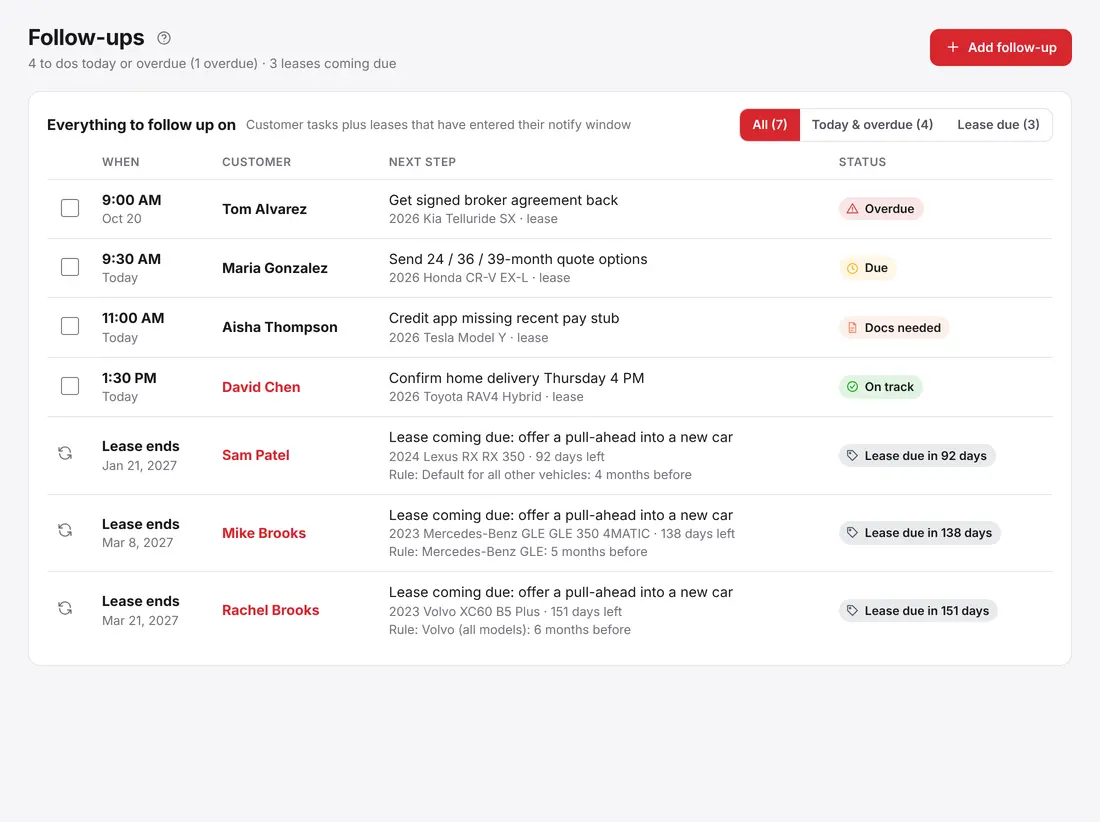
- A lease end date on each car a customer drives, with timing rules by make and model that put the customer on a follow-up list.
- Deal money in the shape brokers use: gross, COD collected, dealer owes, net profit, rep commission.
- Dealer scorecards that show who pays and how fast.
- A list for lease returns going back to banks, with turn-in points and mileage.
- A driveway fit finder and real car pictures to send customers.
The usual approach is custom fields, workflows and sometimes a consultant. That can work, and if you already live in a generic CRM and are happy, you may not need to move. The cost is setup time and the upkeep of what you built.
A side-by-side look
| Need | Spreadsheet | Generic CRM | LeaseDash |
|---|---|---|---|
| Lease-end reminders by make and model | Manual | Custom build | Built in |
| Dealer owes and commission math | Your formulas | Custom build | Built in |
| Dealer scorecards | Your own sheet | Custom build | Built in |
| Lease returns and turn-ins | A separate list | Custom build | Built in |
| Roles and what each person sees | Not really | Yes, general purpose | Admin, Supervisor, Sales rep, plus groups |
| Books next to deals | No | Usually no | Optional Accounting package |
| Cost to start | Free | Varies | From $170.75 a month, billed yearly ($2,049 once a year by card, renews automatically), 14-day free trial |
Good to know
To be fair: LeaseDash is not a lease calculator, and it does not replace your desking tool. Dealers do not log in to it, and it has not been audited by a third party.
Need something we don't have yet? We'll build it.
LeaseDash customizes for an agency's needs. If you want a feature, a report or a connection to another tool that is not there yet, tell us what your desk needs and we will build it with you. Contact us and describe it in a few words.
Moving from a spreadsheet
You do not have to retype. Save your sheet as a CSV, and import it into Leads or Customers: LeaseDash guesses which column is which, shows you a preview and skips rows with a problem, with an explanation for each. Nothing is saved until you press Import on the last step, people who are already on file are skipped, and importing the same file twice is safe. The limit is 2,000 rows and 2 MB per file, and setup and data import help are available with every plan. See Import leads or customers from a spreadsheet.
What it costs
Solo is $204 a month by card, card processing included ($1,999 a year by bank (ACH), $2,049 by card) for one or two people. Team is $409 a month ($3,999 a year by bank, $4,099 by card) for 1 to 5 users, and it is the plan we recommend even for one person. Agency is $819 a month ($7,999 a year by bank, $8,199 by card) for up to 15 users. Every plan starts with a 14-day free trial. See pricing.
Next steps
Read the CRM built for car-lease brokers for how each part works, or book a demo and bring your spreadsheet.